 EnglishEN
 SchweizCH
 EspanolES
 DeutschDE
 OsterreichAT
 ItalianoIT
 CestinaCS
 MagyarHU
 SlovencinaSK
 SlovenscinaSI
 EllinikaGR
 BelgieBE
 RomanaRO
 PortuguesPT
 PolskiPL
 IrelandIE
 AustraliaAU
 SrbijaRS
 ShqipAL
 MakedonskiMK
 NorskNO
 HrvatskiHR
 New ZealandNZ
 DanskDA
 CanadaCA
 LuxembourgLU
 SuomiFI
 FrancaisFR
 NederlandsNL
 SvenskaSV
 TurkceTR
Use a practical Chicken Road strategy with stake formulas, cash-out maths, break-even reach rates, mode checks and a session review that avoids chasing.
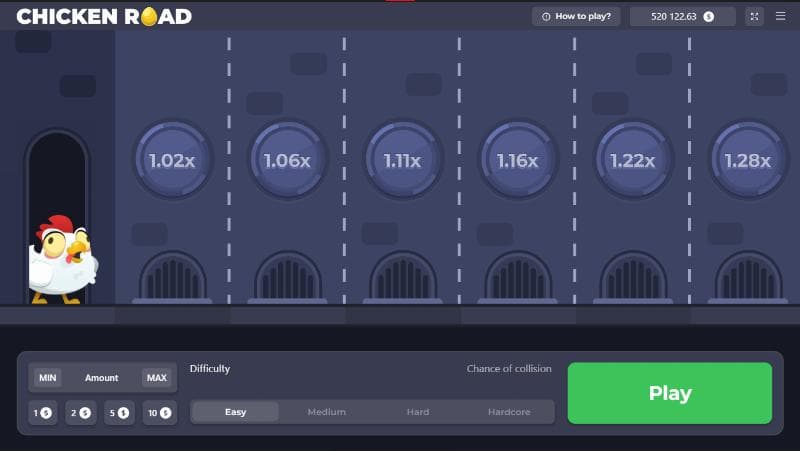
Chicken Road demo
Use the free Chicken Road demo to learn controls, mode changes and cash-out timing. A useful practice session records decisions instead of celebrating a pretend balance.
- Learning mode
- Free play
- Money risk
- None in demo
- Main skill
- Cash out
Updated 2026-07-13
Quick answer
Chicken Road demo play is useful because it shows how fast each step changes the multiplier and your decision pressure. Treat it as practice, not proof that a future real-money run will behave the same way.- Start with several no-stake runs before judging the game speed.
- Pick a cash-out point before each run and follow it.
- Open the real-money game only after checking rules, RTP, terms, and limits.
Featured tool
Live demo access
The embedded demo opens through our protected demo path, so provider launch details stay out of public pages.- No deposit required in demo mode
- Open full screen if the frame feels tight
- Chicken Road 2 demo is now verified
Useful next checks
Chicken Road demo play is useful because it shows how fast each step changes the multiplier and your decision pressure. Treat it as practice, not proof that a future real-money run will behave the same way.
Check Chicken Road RTP by version, compare the original 98% listing with Chicken Road 2.0 at 95.5%, and understand theoretical versus actual return.
Compare Chicken Road casinos with a transparent 10-point check covering licence, exact game access, withdrawals, bonus rules and safer gambling tools.
Play Chicken Road on iPhone or Android safely, compare mobile browser and casino app access, avoid fake APKs and run a practical control and cashier check.
How to use the demo properly
The best demo session is structured. You are not trying to win pretend money; you are learning how decisions feel when the next step looks tempting.
Run short drills
Play small batches of rounds and stop after each batch to review whether you followed your plan.
- Choose an exit before the first step.
- Do not move the exit after a near miss.
Test each mode
If the client offers difficulty modes, compare how the multiplier changes and how quickly pressure builds.
- Easy is useful for pacing.
- Higher modes can feel exciting but punish indecision.
Check the game screen
Use demo time to find the information button, rules page, paytable area, and any mode notes.
- Look for RTP in the client.
- Check whether terms mention version differences.
Before switching to real money
A demo win does not make the next run safer. The switch to a casino should happen only after practical checks are complete.
Set a session budget
Use a fixed amount you can lose without changing your day, and stop when it is gone.
- No chasing.
- No stake jumps after losses.
Read bonus terms
Crash-style and instant games may be excluded from bonus play or carry special limits.
- Check wagering rules.
- Confirm max bet and game contribution.
Verify support tools
A serious casino makes deposit limits, cool-offs, and account controls easy to find.
- Set limits before playing.
- Use cool-off tools early.
A 20-round demo practice protocol
Twenty rounds are not enough to judge the mathematics of the game, but they are enough to test whether you understand every control and can follow a written plan.
Rounds 1 to 5: learn the screen
Find the stake control, difficulty selector, play button, cash-out action, balance display and game information area. Do not optimise results yet.
- Confirm every tap before playing quickly.
- Open the rules and RTP screen at least once.
Rounds 6 to 10: compare modes
Test Easy, Medium, Hard and Hardcore when those four official modes are available. Note how the multiplier curve and decision pressure feel.
- Keep the pretend stake unchanged.
- Do not infer probabilities from five rounds.
Rounds 11 to 20: follow one rule
Choose one cash-out target before each run and record whether you followed it. The useful result is rule compliance, not the demo balance.
- Mark planned exit and actual exit.
- Restart the drill after changing mode.
What the demo cannot tell you
Free play is a product test, not evidence that a paid session will be profitable. Separate what you observed from what still needs verification at the casino.
It cannot predict the next run
A streak in demo does not make the next paid step safer. Previous outcomes are not a signal to increase the stake or move the cash-out target.
- Ignore hot and cold streak stories.
- Never convert a demo streak into a larger deposit.
It cannot verify a casino
A provider demo does not prove that an operator is licensed, pays withdrawals promptly or offers the same game configuration in your market.
- Check operator eligibility separately.
- Verify the live client before paid play.
It cannot approve bonus play
Bonus contribution, excluded-game rules and maximum stake limits belong to the casino promotion, not the demo client.
- Read the promotion terms.
- Use cash funds only when bonus rules are unclear.
Practice evidence
What to record during demo play
A short note after each batch turns free play into a repeatable product check instead of an unstructured session.| Check | Record | Why it matters |
|---|---|---|
| Controls | Mis-taps or hesitation | Cash-out controls must be clear before money is involved. |
| Mode | Selected difficulty | Mode changes can alter risk and multiplier behaviour. |
| Plan | Planned versus actual exit | This measures discipline without pretending to forecast results. |
| Client | Rules and RTP location | You should know where to verify the active version later. |
Do not use a small demo sample to estimate hit rates, RTP or a winning pattern.
Demo session checklist
Use this before any real-money step.
- Played enough demo rounds to understand the step rhythm.
- Picked a cash-out plan and followed it without moving the goal.
- Found the game info screen and checked mode notes.
- Confirmed you can stop after a run without chasing.
- Checked casino eligibility, payment terms, and safer-play tools.
- Recorded planned and actual cash-out decisions for ten demo runs.
Demo FAQ
Short answers for players who want the practical version before they open a casino lobby.
Is Chicken Road demo free?
Demo availability depends on the casino or provider catalog, but when demo mode is available it should not require a deposit.
Can demo results predict real-money results?
No. Demo play teaches pacing and controls, but it should not be treated as a predictor of the next paid run.
Should I play demo before depositing?
Yes. Demo play is the cleanest way to learn cash-out timing, mode differences, and the game screen before using real money.
How many Chicken Road demo rounds should I play?
Use enough rounds to test every control, every available mode and at least ten planned cash-out decisions. The goal is familiarity and rule-following, not a statistically meaningful win rate.
Is the Chicken Road demo identical to real-money play?
On a regulated operator, free play should represent the corresponding paid game accurately, but you should still verify the live rules, RTP, version and casino terms before depositing.
Definitions
Demo facts and verification
We separate provider-published game facts from player guidance. Facts are checked against the linked source; strategy examples are calculations, not promises of winning.- Official Chicken Road game pageInOut Games
- Rules for play-for-free game resultsUK Gambling Commission

Ready to play with a plan?
Start in demo, verify the game client, then use the selected casino link only when the checks are clear.
Open selected casino